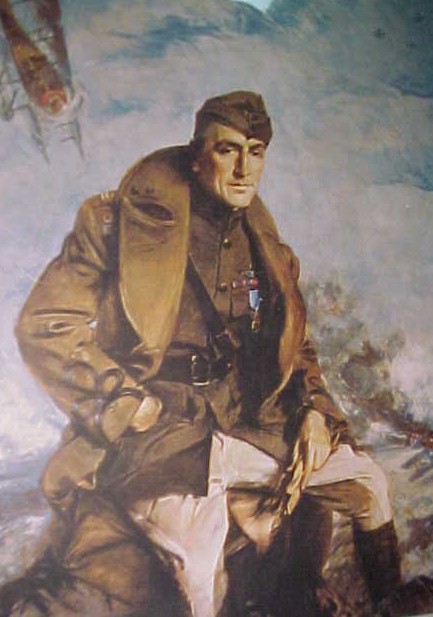
Direct quote from: Seven Came Through, Rickenbacker's full story, by Captain Edward V. Rickenbacker, Doubleday, Doran and Company, Inc., 1943. PP 103 - 111
In 1922, before this happened, I married. My wife and I went to Europe on our honeymoon. We traveled through France, England, Italy, and Germany. Thanks to the reputation that had come to me during the [first world] war, I was able to meet many of the leading statesmen and industrialists of Europe.
In Germany I came to know many of the famous airmen who had fought so brilliantly on the Western Front. One meeting I shall never forget. It took place at the Hotel Adlon in Berlin. Four German airman called to pay their respects -- Hermann Goering, Erhard Milch, Vandlent, and Ernst Udet. Two had fought in the famous Richthofen Flying Circus.
Now my squadron had tangled with the scarlet planes of the Flying Circus on many an occasion, and I personally had shot down two of the Richthofen aces. But soldiers do not hold grudges; they bore me no hatred. In fact, they greeted me almost like a long-lost friend.
Goering was stout even then, but except as a war hero he meant little or nothing to the German people. The other three also were without importance. The Versailles Treaty had broken up the German air squadrons, and these airmen, or so I thought, had virtually nothing with which to work. Yet all four were rich in a single purpose: to avenge the defeat and restore Germany to power on the continent.
Goering said something I still remember. He said, "Our whole future is in the air. And it is by air power that we are going to recapture the German empire. To accomplish this we will do three things. First, we will teach gliding as a sport to all our young men. Then we will build up commercial aviation. Finally, we will create the skeleton of a military air force. When the time comes, we will put all three together -- and the German empire will be reborn."
Germany was then caught up in the spiral of inflation. The merchants in the stores and shops had to use revolving price tags on their merchandise to keep up with the constantly declining mark. When I gave the floor waiter and the maid at the hotel fifty marks apiece as a tip, Mrs. Rickenbacker was shocked by my extravagance, but the Germans bowed and scraped and could not find words to thank me. But the American money, our five days at the hotel cost me in tips exactly six cents. Under such circumstances it was difficult to take these German airmen seriously. Germany was a bum among nations. No one worth while had ever heard of Hitler.
In 1935 I returned to Europe. I had just been through the backbreaking job of building and organizing Eastern Air Lines. In addition, the friends of Will Rogers, who that summer was killed in an airplane crash in Alaska, had asked me to head the national drive to raise funds for the memorial to him. Between the drive and my own work I brought myself close to a nervous breakdown. I decided to take a trip to Europe -- partly to rest up, partly to have a look at commercial and military aviation in England, France, Italy, and Germany.
On arriving in Paris I got a telephone call from Lord Beaverbrook, publisher of the great Daily Express of London and a powerful chain of newspapers. I had first come to know him years before in Toronto where he was plain Max Aitken. Beaverbrook invited Mrs. Rickenbacker and myself to join him for breakfast at the Ritz. The conversation was amiable and aimless, but the thought struck me that Beaverbrook seemed to be more than politely interested in the reasons that had brought me to Europe. He asked me about my itinerary.
"When do you expect to be in England?" He asked.
I looked at my notebook. "Three weeks from this afternoon at four o'clock," I answered.
"Fine," he said. "Could you both have dinner with me?"
In due time I arrived in Berlin. Thirteen years had brought a great change in Germany. Hitler was in power and the country had a new vitality to it; there were no more scenes such as I had witnessed in 1922 when the streets were jammed with frantic people trying to get rid of their marks before another inflationary rise wiped out their savings. Again I met the same four airmen. Goering, blazing with medals, had become Hitter's Number 2 man and chief of the new German Air Force. Milch was his deputy; Vandlent was in charge of highly secret research; Udet was in command of all aircraft production.
"Herr Eddie," said Milch, "remember what was told you in 1922?"
"Yes," I said, "I remember it vividly."
"Well," said Milch, "come and see."
I visited the Junkers factory where 20,000 men, they told me, were working night and day building air planes. Udet showed me the new Richtofen squadron, which we thought we had driven out of the air. its headquarters were carefully hidden in the pine woods twenty miles or so from Berlin. I saw the with amazement hangars made of concrete and repair shops that were bombproof. There were eighteen planes in the squadron, and it puzzled me that six were merely trainers. "But why trainers?" I asked.
One of the fliers told me boastfully. "We use them to make our clerks, our mechanics, and our kitchen police into fliers. Every squadron in Germany is doing the same thing."
That opened my eyes. The four derelicts of 1922 were assembling a striking force that could sake Europe to its foundations.
My wife and I arrived in London on schedule and went to the Savoy Hotel. An hour later Beaverbrook's secretary arrived with invitations for dinner and following evening at his town house.
The first guest I met was Sir Robert Vansittart, Permanent Undersecretary of State in the British Foreign Office. There were cocktails, but before I had one to my lips Mr. Vansittart led me to a corner, and holding the lapel of my coat, he demanded, "When will 'they' be ready?"
"When will who be ready?"
Vansittart said, "Why, the Germans!"
So that was why I had been invited. Quite a few guests were present, and the discussion was rather hot. I gave it as my frank opinion that "they" would be ready in all probability within five years, and a minimum of three. I based this prophecy not only upon what I had seen of the German factories and airfields, but on the fact that the men then in command of Germany's destiny had been underlings in the last war and knew -- or thought they knew -- the causes of their defeat. They weren't going to make the same mistakes.
Vansittart nodded his head and in a gloomy tone said that my estimate was to hopeful so far as England was concerned, the Germans would be ready within two years.
I said, "Well, if all Englishmen are a jittery as you are, you can be sure that the Germans know it and they will strike."
Beaverbrook was not impressed. He did not believe it. Neither did my own people. When I returned to the United States I buttonholed many of the high officials of the Army, Navy, and the Government. I told them what I had seen in Europe: the growing strength and purpose of Germany and Italy; the unreadiness of France and England. The Germans and Italians, I said, were going forward, particularly the Germans; a great danger faced us unless we acted at once along certain fundamental lines. For saying that I was called an alarmist and warmonger.
I say now, with neither pride nor satisfaction, that my prophecies were not only fulfilled but exceeded by far. Billions of dollars were spent on useless projects that might well have been used to make the nation strong in the air and on the seas. I am convinced that Hitler would never have struck had we possessed even a small part of the military power that we are mobilizing now.
As early as April 1939, in an article in Collier's, I proposed a national program of 50,000 airplanes. Not military airplanes -- because of the rapidly changing design the value of a combat airplane approaches zero after a couple of years. What I wanted the country to have then was 50,000 transport airplanes. Such a fleet would help us move goods faster; it would bring into being a great national aircraft industry which would be converted quickly in the event of war. Furthermore, it would stimulate the training of thousands of pilots and ground crew men, who are as indispensable to air power as aircraft. The truth was that we Americans, who talked so glibly about being air-minded, had almost no comprehension of what being air-minded really meant. The press was full of foolish talk about "darkening the heavens" with American planes. Yet the entire air transportation system of the United States was built around less than five hundred commercial aircraft, We did not have a single school capable of training pilots of maintenance men on a large scale. In terms of air power we were a second-class power.
In 1940 Mr. Roosevelt called for what was then considered an enormous program of 50,000 military aircraft. It was clear that we had to set some kind of figure to shoot at, but to me 50,000 did not seem very impressive. From such studies as I had made, I could not see how we could possibly hope to hold our place in the world with less than 250,000 aircraft and pilots, maintenance men, and workers in proportion.
We are all air-minded now. Millions of words have been written on the subject of air power; many extravagant predictions are being made. In many respects the logic of air power has been injured by the foolish claims of its disciples. No man who has made a truly serious study of the strategic situation believes that air power by itself will win the war. It must be used in conjunction with other weapons. But this I believe: the decisive battles will be fought and won or lost in the air. Whichever side controls the air will ultimately control everything. In the great Battle of Britain in the summer and fall of 1940 Goering came within a hair's-breadth of sweeping the R.A.F. from the skies. Had he succeeded, the Luftwaffe would have ruled the air above all Europe. Goering failed, and from that moment on, I am convinced, Hitler lost his great chance to win. The question is: How soon can we build up our own air power, in conjunction with that of Britain and Russia, to smash the Luftwaffe into the ground? Once we smash it, the industrial system -- the factories, the railroads, all the communications -- will lie exposed to our bomb sights.
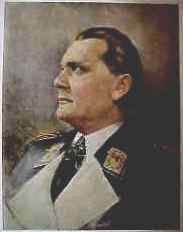
The fact that Goering was unable to smash England with his air power has persuaded many Americans that air power at best is an indecisive weapon. If Germany, with all the years of preparation, could not finish off England, how can we expect to finish of Germany, with the same weapons?
The answer is that air power has not yet been used in anything like the concentration required. The comparatively small quantities available to ourselves, the British, and our other Allies, have been dispersed over all the world. But commencing in the summer of 1943 this situation will change. As the output of the aircraft industry rises we shall see raids on the scale far exceeding those that now make headlines. A bombing raid is only an exercise in transportation. The problem is basically one of moving cargo -- in this case bombs -- to a specified destination at a fixed time. We Americans have always understood transportation; we have led the world in that field. And in due time we and our Allies shall bring Germany and Japan under a weight of bombs such as Goering, in his wild dreams of 1922 and 1935, never visualized.

Last updated on
© L, Dighera 1998-1999. All rights reserved.